Sunday, May 10, 2009

Cable Management: The boy-scout way


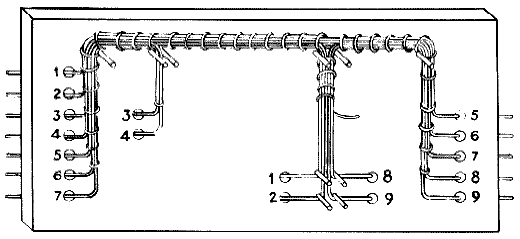
Lifehacker recently featured an article on how to tie cables using a continuous piece of twine or rope. In my opinion this sure beats buying bunches of cable ties and zip ties. This method is also a whole heck of alot more flexible as well (no cutting and using fresh zip ties). It also brings out the ub3r boy scout side of me.

Wireing and Cabling: How To Lace Cable Harnesses

Wednesday, April 22, 2009

Location Re-Location


After spending a little over one and a half years in my current apartment. I seem to have outgrown the renters lifestyle. Several of my friends and I have gone in together to purchase a house of our own. I'll be packing up my belongings within the next few months and moving into the new digs. I expect to have room to expand my workshop and office areas. This can only mean that there are many fun projects to come. In fact, I'm already postponing the construction of several treatises until after I settle into the new place. So here's to new beginnings. I hope to be moved in and ready to rock by the time I write my next post.

P.S.

If there so happens to be anyone in the North-Atlanta area looking for a place to stay, I am in need of someone to sub-lease my current apartment until the end of the year.

Tuesday, March 3, 2009

Latest Build: Sound Lab Mini Synthesizer

I recently got around to building a project I've been longing to try for quite a while now. I ran across Ray Wilson's website: Music from Outer Space. The Sound Lab imeadtiatley cought my attention.
In my search for a suitable enclosure I ran across a K-NEX box in a thrift store, complete with bags of K-NEX pieces, gears and wheels, perfect for front panel knobs. For $3, this case and collection of knobs blows the typical $30 tab for pre-fab eclosures and molded plastic knobs out of the water.

I've included some of my build pictures. Hope you enjoy, samples coming soon.

I've been planning this build for a while and last week, I finally had everything I needed to get started.


The P.C. board, almost complete.


Inside view of the case. This is barely half the amount of wires in the finished product.


Preliminary tests of the oscillators, working well!

The box, with pots mounted, switches coming soon.

Monday, March 2, 2009

Picture of the day, Guess what it is.


Just a bit from my latest project.

Monday, February 2, 2009

New Years Resolution: Removable Media Backup

Removable and portable media, I've found, is one of the toughest things to make consistent backup copies of. After all, there is really no way to predict when and/or where my multitude of drives will be plugged in. Which led me to a simple solution, back them up when they are plugged in.

In the past, I've used rsync to make backups on a regular basis (using cron jobs). I devised a similar scheme to backup removable media.

A simple python script scans for mounted media. Drives that have been configured to be backed up are copied through rsync and ssh to the specified backup location. Drives/media not configured for backup are simply ignored.

The script looks for a two line text file in the root directory of each mounted drive to designate whether or not to backup the drive. The text file contains the volume's name (not to be confused with the portion label, this name is only for aesthetics and organization) and also the location the drive should be copied to on a remote host. The script then continues to archive the drive to the location specified. When done, it moves on to the next drive and so on.

The script and example config file are included in a tarball below. Comments and improvements welcome.

Download the Drive Booty script [Box.net link]

Creative Commons License
DriveBooty by Dana Simmons is licensed under a Creative Commons Attribution-Share Alike 3.0 United States License.

Sunday, January 4, 2009

Arduino Control Voltage: Rough Code

I've worked a little more on the Arduino Control Voltage. The processing code bellow takes midi input from any midi device, reads the note and velocity information and then spits it back out over the USB Serial connection to the Arduino board. It's a roundabout convoluted way of getting midi information (midi being a serial data stream to begin with), I hope to get a direct midi input wired up soon.
Arduino PWM to CV out circuit


import promidi.*;
import processing.serial.*;

int com = 0; //Comport/Serial port #
MidiIO midiIO;
Serial sOut;
PFont font;
int pit;
int vel;
void setup(){

font = loadFont("ArialMT-40.vlw");
midiIO = MidiIO.getInstance(this);
println(Serial.list());

midiIO.printDevices();

midiIO.plug(this,"getMidi",0,0);
sOut = new Serial(this, Serial.list()[com], 9600);
}

void draw(){
background(255,255,255);
textFont(font,15);
fill(0,0,0);
text("Midi Data",0,14);
textFont(font,12);
text("Note:",0,28);
text("Velo:",0,42);
textFont(font,12);
text(pit,42,28);
text(vel,42,42);
}

void getMidi(Note note){
println("Got a note!");
vel = note.getVelocity();
pit = note.getPitch();
println(vel);
//println(pit);
sOut.write(vel);
sOut.write(pit);
}


Bellow is the (now) simple code to be uploaded to the Arduino board which just reads the serial data and controls the PWM output.

/*Arduino CV. Reads note and velocity information form the serial line and outputs to PWM pin */
byte note = 0;
byte vel = 0;
int synPin = 11; //Pin # for pitch CV output

void setup() {
Serial.begin(9600);
}

void loop() {
if(Serial.available() >= 2 ){ //Wait untill there is enough information
Serial.println(Serial.available(),DEC);
vel = Serial.read(); //FIX ME: Implement velocity sensitivity (VCA Control)
note= Serial.read();
analogWrite(synPin,note);
}

}

Creative Commons License
Arduino Control Voltage by Dana Simmons is licensed under a Creative Commons Attribution-Share Alike 3.0 United States License.
Based on a work at code.google.com.
Monday, December 29, 2008

First revision: Arduino Control Voltage

The recent holiday brought into my possession a shiny new Arduino Duemilanove board, my first real project with it? Control Voltage output to control my self titled Uranus synthesizer (based on the Voice of Saturn synth). In any case, after a couple long nights I cam up with the sketch bellow, I've tested it and it seems to work with a little adjustment from the pot on the output.

I have yet to attempt at getting the thing tuned, but by runing the PWM output of the Fading sketch (a steady ramp up and down from 1 to 255) i was able to verify that it does indeed control my rather excentric synth. Thoughts, suggestions and critics welcome.

NOTE: The capacitor in the lowpass filter at the bottom is 470 uF, apologies for not adding the value.


Creative Commons License
Arduino Control Voltage by Dana Simmons is licensed under a Creative Commons Attribution-Share Alike 3.0 United States License.
Based on a work at code.google.com.